Lucaryn blog · Divination & Spiritual Practice · October 27, 2026
Ancestral Spirituality When Your Family History Is Unknown
An ancestral spiritual practice can begin with what is unknown. You do not need a complete family tree, inherited ritual objects or a dramatic story of lineage to make room for remembrance. A personal practice can honor the fact that your life has predecessors while remaining honest about whose names, lives and beliefs you do not know.
An ancestral spiritual practice can begin with what is unknown. You do not need a complete family tree, inherited ritual objects or a dramatic story of lineage to make room for remembrance. A personal practice can honor the fact that your life has predecessors while remaining honest about whose names, lives and beliefs you do not know.
Give the unknown an acknowledged place
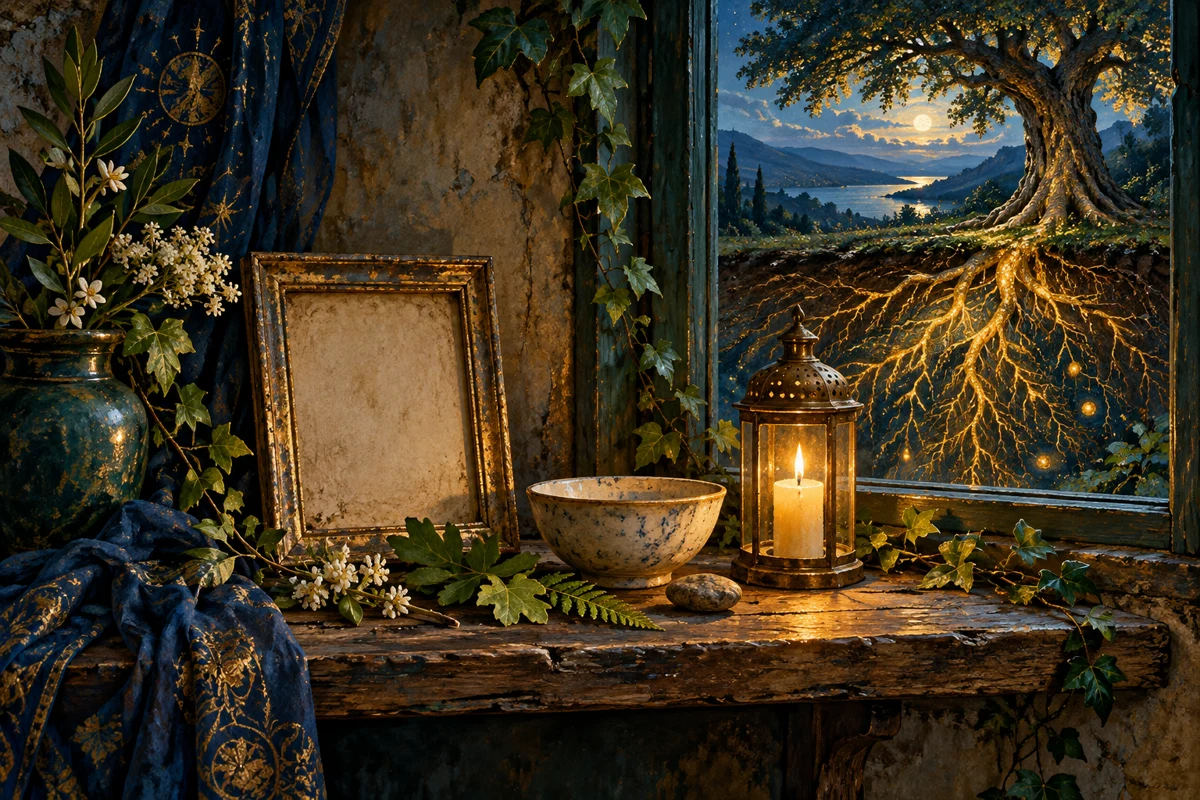
An empty frame, an unmarked page or a simple bowl can represent the limits of your knowledge. The object is a chosen symbol, not evidence of contact. Its purpose is to keep the practice from filling every silence with an invented biography or assigning an identity to an impression you cannot verify.
You may choose language such as “those whose lives came before mine” without naming particular ancestors. If even that language feels uncomfortable, begin with gratitude for a quality you wish to carry forward: care, endurance, curiosity or generosity. Personal spiritual meaning does not require certainty about where every quality originated.
Distinguish family, belonging and tradition
Biological ancestry, the people who raised you and a spiritual tradition are not always the same circle. An adopted person or someone separated from family may hold several kinds of belonging. A remembrance space can reflect that complexity without claiming that one form must cancel the others.
Choose practices you understand and have a clear basis to use. Unknown ancestry is not permission to claim membership in a closed religious tradition or reproduce a ceremony stripped of its context. A quiet personal observance can remain complete in its simplicity; it does not need borrowed authority to become sincere.
Keep impressions and historical knowledge separate
If a name, image or feeling arises during reflection, record it as an impression with the date. Do not turn it into a recovered family fact. Later research may offer a connection, a contradiction or no answer at all. An honest journal has room for each possibility.
A modest practice might include naming what you know, acknowledging what you do not know, and spending a few quiet minutes considering what you wish to pass onward. End by returning the objects to ordinary care. The purpose is an intentional relationship with memory and responsibility, not a demand that the unseen supply missing records.
If family history includes painful or uncertain material, remembrance does not require idealizing every person who came before you. You can honor the continuity of life while choosing which qualities deserve another expression. A spiritual practice can hold reverence and discernment together, especially where the record is incomplete.
Explore Lucaryn’s psychic and spiritual guidance to find an approach that respects your beliefs and the questions you want to explore.
Original symbolic artwork of an ancestral remembrance space; it does not depict a documented family altar or historical tradition.