Lucaryn blog · Divination & Spiritual Practice · November 13, 2026
Keeping an Oral Spiritual Memory When You Do Not Want to Write It Down
Preserve a personal spiritual reflection through speaking and listening, with clear distinctions between memory, interpretation and later additions.
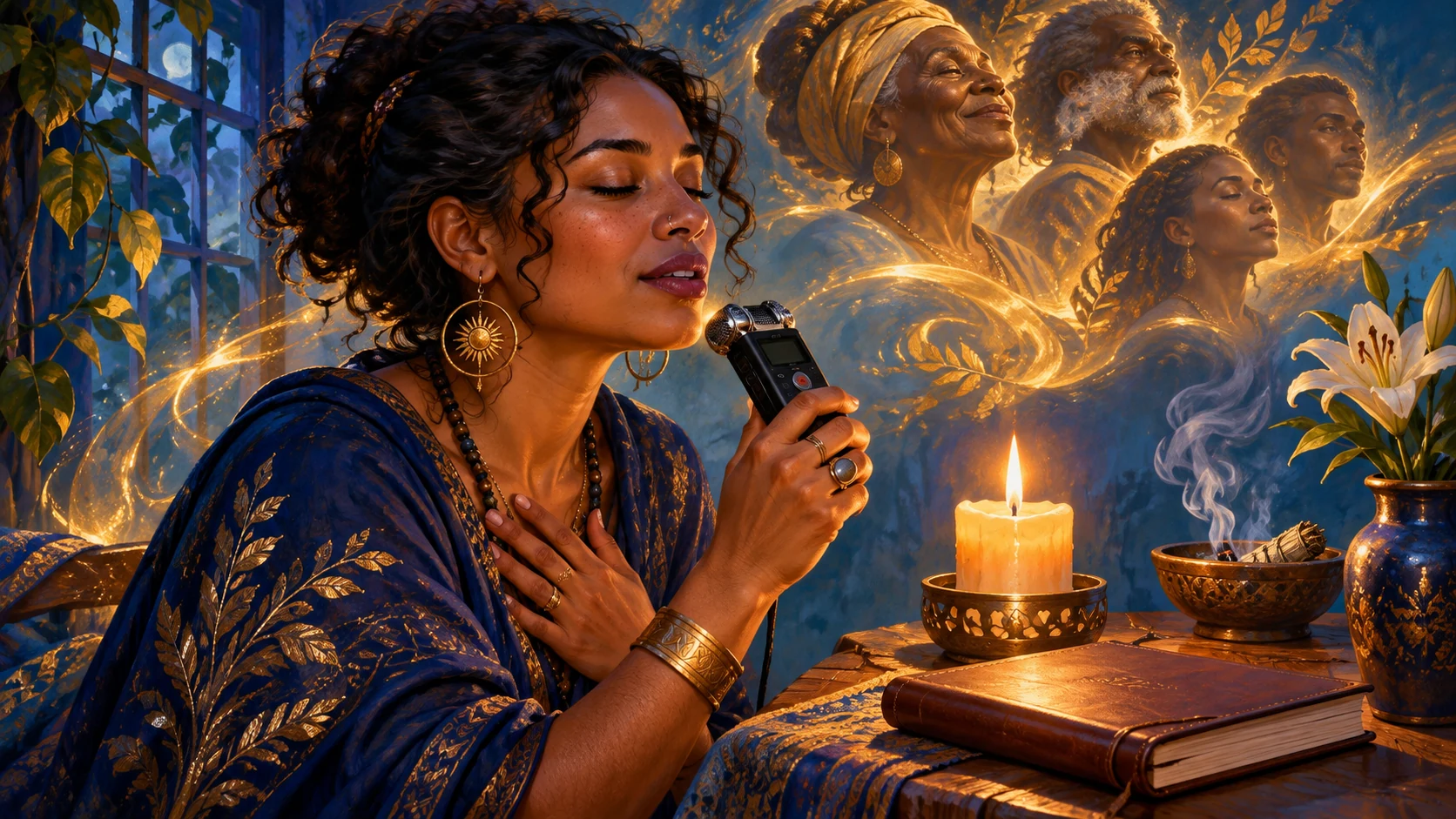
A spiritual journal does not have to begin on a page. Speaking a memory aloud can preserve its rhythm, uncertainty and emotional emphasis in a way that feels more natural than writing. You can use a private recording or simply repeat a short account in a deliberate moment of reflection.
The aim is to keep your own experience recognizable. An oral record need not become more certain or more dramatic each time you return to it.
Decide what you want to preserve
Choose one experience, image or question rather than trying to narrate an entire spiritual history at once. Say what happened, what you remember directly and which details are unclear.
You may be recording a dream, an intuitive impression or a moment associated with a meaningful place. Name the kind of experience before explaining its significance. That gives a future listener, including your future self, a clear beginning.
If the account includes someone else’s private information, consider whether those details are necessary. A personal spiritual record can preserve your reflection without becoming a record of another person’s life.
Give observation and interpretation different sentences
Begin with the description you can honestly offer. Then introduce the meaning you drew from it as a separate part of the account. You can say that an image reminded you of something without claiming that the association proves its origin.
This simple distinction can be especially useful when the spoken account flows quickly. The warmth of your voice may make an interpretation feel settled even when you originally held it as a possibility.
Leave uncertainty audible. Pauses and phrases such as “I do not remember that part” can preserve the experience more accurately than replacing every gap with a smooth narrative.
Mark the moment of telling
If you make a recording, begin by saying the date of the experience if you know it, and the date you are speaking. A memory recalled much later can still matter, but the distance between the event and the telling deserves to remain visible.
When you return to the account, make a new note or recording for later reflections rather than silently treating them as part of the original experience. You may understand the moment differently without claiming that you knew the later meaning at the time.
If you do not want a recording, choose a brief spoken form that is easy to remember. It can hold the central question without pretending to preserve every detail exactly.
Let listening be a separate practice
Listen later with attention to what you actually said. Notice the point where your tone changes, where you sound curious or where the account moves from description into explanation.
You do not need to diagnose every hesitation or assign spiritual significance to a recording artifact. The listening is a chance to meet your own words with a little more space.
A private recording can also remain private. Decide who, if anyone, may hear it, and keep the practical storage of personal material consistent with that choice.
Preserve a living record without rewriting the past
A spiritual memory may continue to unfold in meaning. The spoken record gives that unfolding a reference point rather than a final authority over your life.
Return when there is something worth hearing, not because the account must produce a new revelation each time. Your voice can become a gentle means of remembrance: a way to keep the original question, the limits of recall and the meaning that later grew beside it.
Explore Lucaryn’s spiritual guides or connect with a reader in Lucaryn’s own Marketplace.
Symbolic artwork of a fictional personal practice; not an actual recording, ancestor or documented ritual.