Tarot & Divination
Tarot Journaling When You Disagree With a Card
A tarot journal can include disagreement. Use these prompts to explore a card, test an interpretation, and keep your own judgment in the reading.
Real people. Brighter connections.
A MORE ENLIGHTENED WORLDTHE LUCARYN JOURNAL
Explore the cards, symbols, and questions that open a new way of looking.
A tarot journal can include disagreement. Use these prompts to explore a card, test an interpretation, and keep your own judgment in the reading.
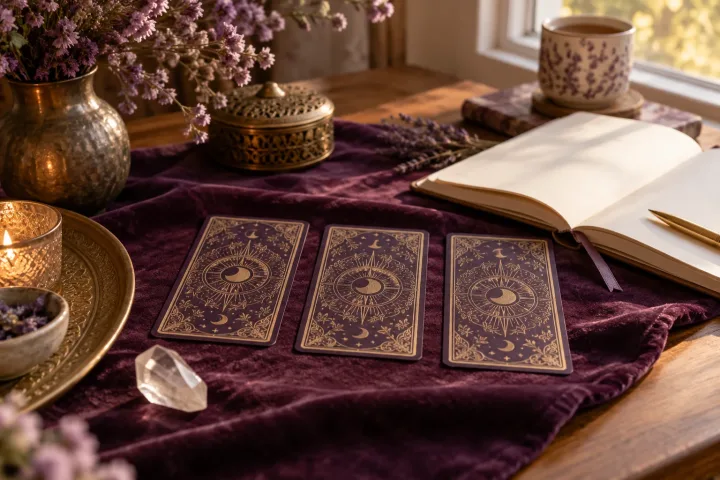
Try a three-card tarot spread for a crossroads: what matters, what needs attention, and one practical next step. Keep the final choice in your hands.
Explore beautiful oracle messages with discernment: receive encouragement while questioning exceptionalism, certainty and interpretations that erase other people’s choices.
Explore the empty center of a sacred circle as a spiritual symbol of openness, humility and possibility, rather than a demand for an immediate message.
The cards that do not appear can raise an interesting question. They cannot, by their absence alone, declare a part of your life empty.
A practical spiritual guide to closing tarot and oracle sessions, containing the reading and leaving unanswered questions open without endless clarifiers.
Explore numbered tarot cards as symbolic relationships and stages, without turning a sequence into a guaranteed timetable or universal numerology rule.
Explore contrasting oracle cards through spread positions, symbolic tension and focused clarifiers without forcing uncertain messages to agree.
Learn how a tarot significator can orient a spread without fixing someone’s identity, appearance, role or future.
Compare the same tarot cards across two decks to explore imagery and interpretation, while preserving the original question and avoiding repeated answer-seeking.
Create a personal symbol dictionary for dreams and divination that records context, sources and changing associations without treating symbols as fixed predictions.
A flowing page can feel mysterious. Give automatic writing room for symbolism without treating the words as proof of a spirit’s identity or a command.