Lucaryn blog · Divination & Spiritual Practice · October 28, 2026
Ancestral Spirituality Through a Handwritten Family Recipe
Explore a handwritten family recipe as a place for ancestral remembrance, sensory attention and spiritual practice without inventing family history.
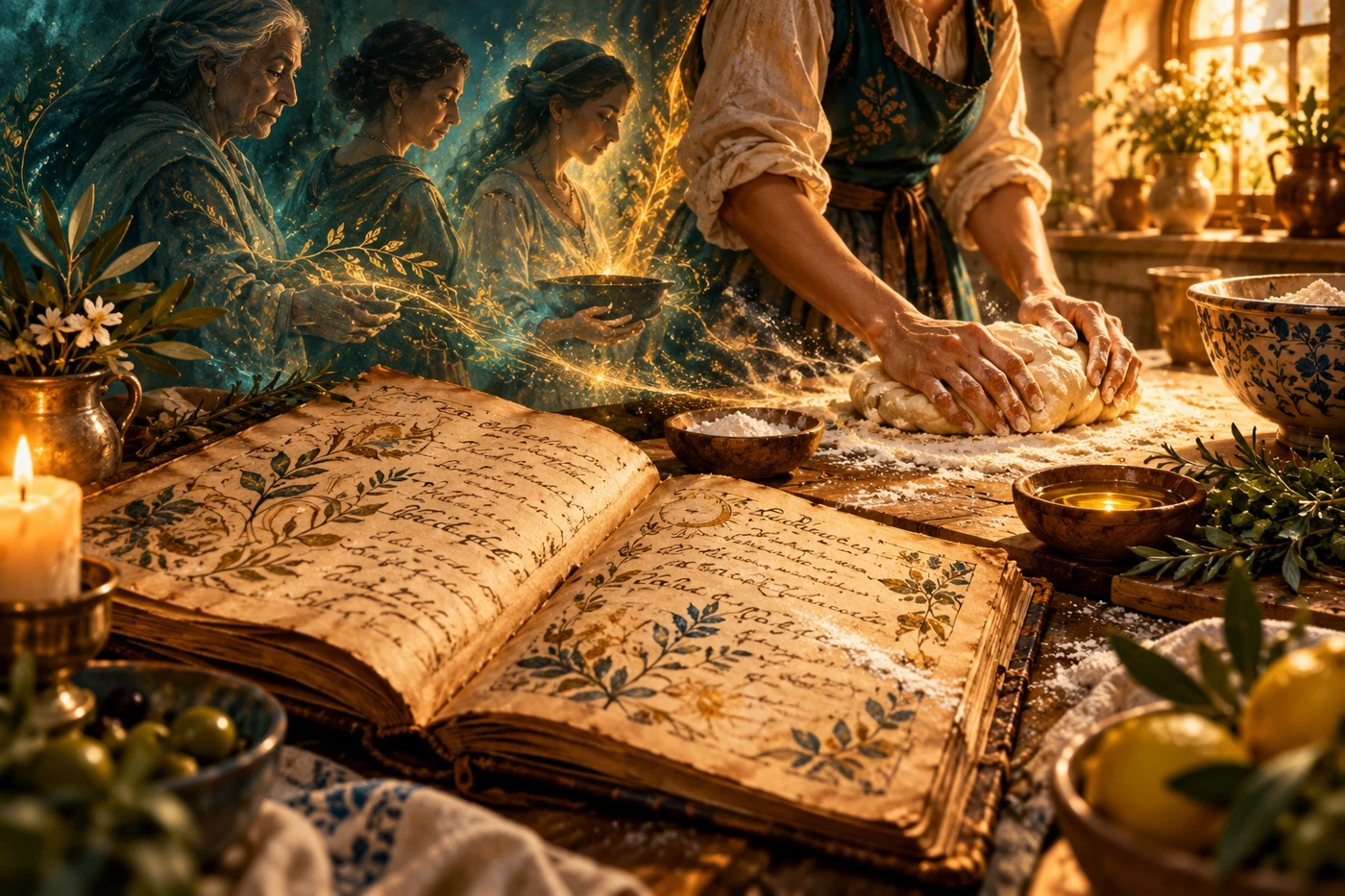
Original AI-generated symbolic artwork; the people and setting do not depict actual advisors, clients or documented events.
A handwritten recipe can become a small ancestral altar without leaving the kitchen. The ingredients, corrections and familiar turns of phrase may preserve traces of how somebody cared for a household or marked an occasion. In an ancestral spiritual practice, preparing that food can offer a way to remember and reflect. It does not require claiming that every sensation is a message from the dead.
Begin with what is genuinely known. Who wrote the recipe? Who passed it to you? Is the dish connected with a place, celebration or ordinary meal? If those details are missing, leave room for the gaps. A meaningful practice can honor an incomplete inheritance. Inventing a beautiful origin would replace the very history you are trying to approach.
Read the page before beginning the ritual
Notice the practical marks: an altered quantity, a stain, a substitute ingredient or an instruction that assumes knowledge nobody wrote down. These details can reveal how a recipe was used, although they may not explain who changed it or why. Treat your impressions as questions. If living relatives wish to share memories, listen to their accounts without asking them to confirm a spiritual interpretation.
Protect the original page if it is fragile. Work from a copy and keep flames, steam and spilled ingredients away from it. A spiritual practice need not put an irreplaceable object at risk. You can place the copy nearby, say the name of a known ancestor and acknowledge the people whose names have not survived. Simple attention is enough to give the preparation a ceremonial frame.
Let sensory memory remain specific
As you cook, notice texture, sound and scent. A memory may appear; so may an association you cannot place. Write down the difference. I remember this kitchen is different from I imagine how this kitchen might have felt. Both can be part of reflective work, but they are not the same kind of knowledge. Keeping that distinction makes the spiritual experience more honest, rather than less enchanted.
Within some ancestral traditions, food is offered as part of a relationship with the departed. Practices differ widely across families, religions and cultures. Follow the forms that actually belong to your tradition or that you have permission to learn. A private act of remembrance does not require borrowing a closed ceremony or describing one family's custom as a universal ancestral rule.
An inheritance can contain mixed feelings
Family food does not always carry uncomplicated warmth. A recipe can be tied to grief, distance or a person you do not wish to idealize. You may choose to remember a skill while declining to celebrate everything about its source. Ancestral spirituality can include discernment about what is carried forward. Reverence does not require rewriting difficult history into a comforting legend.
You can also adapt the dish for present needs, clearly noting your changes. The spiritual meaning need not depend on recreating every ingredient exactly. Record what came from the inherited page and what you contributed. That creates a visible conversation between continuity and change, instead of suggesting that only an untouched past deserves to be honored.
Close by leaving something truthful behind
After the meal, write a short note about the experience: what you made, whom you remembered, what you learned and what remains uncertain. Date it. A factual note about today's practice may become useful to somebody later. You do not need to attach a prediction or supernatural claim to make it worth preserving.
Explore more psychic and spiritual writing through Lucaryn. A family recipe can be a doorway into ancestral attention because it brings memory into an ordinary action. The sacred element is not a fabricated certainty about who is standing beside you. It is the care with which you approach what has reached your hands.